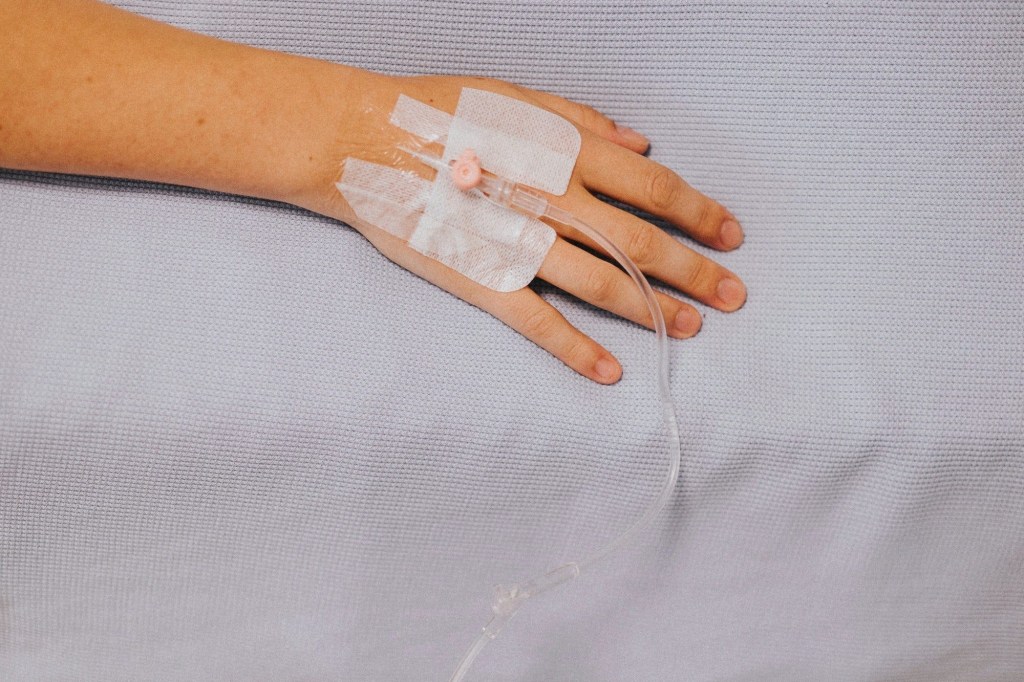
Sympathy refers to one’s ability to acknowledge or share someone else’s feelings, mostly encompassing feelings of concern or sorrow for others misfortune.
Empathy, however, is the ability to understand others feelings as if we were experiencing them ourselves because we actually have personally experienced it, or have been in a similar situation that means we are capable of imagining how they would be feeling.
I used to wonder what my patients went through on their own journey to a diagnosis, what did they feel? what was that frustration and fear like that I see all too often when your body seems to be against you? what thoughts must be running through their minds? what was it like to live with a chronic illness?
Now…. I get it.
Just over 12 months ago I was diagnosed with Serrated Polyposis Syndrome (‘SPS’) …. and then 2 weeks ago I was diagnosed with inflammatory arthritis … what. a. year!
Tonight, I’ll be telling the tale of my SPS diagnosis, explaining what it is and what it means for those of us who have it.
So, it all began mid 2018, I was in the middle of my ‘rural year’ of placement and was spending a fair amount of time in theatres assisting with various surgeries. These surgeries included being part of approximately 30 colonoscopies (colonoscopy = a flexible camera passed up the back package to examine the colon while sedated). I was asking the gastroenterologist some relevant questions and the discussion ventured towards the indications for having a colonoscopy. To my surprise I ticked a fair few boxes and in between the twisting, inspecting and searching through our patients loops of bowel I got a free consultation by this lovely doctor! However, our chat ended with him trying to hide a concerned face and insisting that I should promptly see my GP and get a referral for my own colonoscopy.
So, I ever so confidently walked into my lovely GP’s room, explained my family history of bowel cancer and what the gastroenterologist had told me, but promptly noted my ‘young’ age and that I had not been experiencing ‘worrying features’ (not passing blood, no unexplained weight loss etc). Together myself and the GP agreed that yes, going forward with a ‘screening colonoscopy’ was probably the best idea.
I honestly thought that I knew what I was in for with my upcoming scope…..I mean I had read about it in textbooks, talked to patients about it, and been involved in theatre for sooo many myself right? what could I be surprised by?! well, as it turns out I had a loooooot to learn about the things that go down BEFORE the actual colonoscopy (be warned, the next part talks about poop haha).
So let’s just take a quick minute to discuss the ‘bowel prep’ – the whole idea of a colonoscopy is so that the surgeon can view the inside of the colon yeah? soooo said colon has to be completely free of any and ALL residue … and that means the preparations you are required to drink will literally give you the most horrible and persistent diarrhoea (on purpose!!!) to completely clean you out prior to this thoroughly meticulous inspection! and good lord was I not expecting that haha!
Any-hoooo, I survived this ordeal and the day of my
scope finally arrived!
I had bought a dressing gown into hospital as instructed to put on over the
ever so stylish blue gown that openly gapes at the back – note to self, a half-sized
dressing gown doesn’t count because it won’t actually provide any further
dignity if the aforementioned gapping is still on full exposure – will bring a full-sized
long dressing gown next time!
I wasn’t expecting them to find anything, but little did I know this was just the beginning.
The procedure seemed to finish as quickly as it started, and I remember thinking I had had a horrible dream that something had gone wrong while I was sedated.
A few minutes passed, I quickly became orientated and brushed off the post-nightmare feeling and called the nurse over to ask for a sandwich (no food for 48 hours by this point…. I was starving!), but before I could ask her what options I had for the sandwich fillings she told me that the doctor would be back soon to privately discuss what they found and when I needed to come back.
…. come back?!? what did she mean? this was meant to be a screening thing i.e. I was going to be fine and this was just something I had to tick off my ‘to do’ list!
My specialist eventually came back after what felt like an eternity of ruminating over all of the worst-case scenarios…. he then told me that he had to dissect multiple polyps (a protruding growth within the inner lining of the colon) and that I ‘most likely’ had Serrated Polyposis Syndrome, but that I had to wait for my histology results to come back in a couple of weeks.
Now, I had never heard of this condition before and to be honest a lot of the time as soon as health professionals know that I am a medical student they seem to assume I understand the medical jargon, all of the medical acronyms and the very specific medical conditions they are talking about, but sometimes, like in this case, I just had never come across this term in my studies. I didn’t even know what questions to ask him because – you don’t know what you don’t know right?!?
Anyways he briefly explained what the condition was and handed me a scientific journal article to read about SPS, but said to not ‘google’ too much until I had the histology and could confirm the diagnosis.
These results came back in 2 weeks (longest 2 weeks of my life!), I was driving home one day from a shift at the hospital when I got the call “you do have SPS Tenae, and 1 of the polyps that was resected was already dysplastic (a term that describes how much your polyp looks like cancer – not cancer yet, but one extra step closer), you got very lucky, up to 40% of patients who get this diagnosis already have metastatic cancer at the time of diagnosis’.
I. was. shocked. I felt like I couldn’t even speak and I just thanked the doctor for calling me and hung up.
What did this really even mean? how could I be completely healthy and have no symptoms but have these things growing inside of me with one of them potentially being a cancer in the next few years?!
I called my (at that time) fiancé and as I was reciting the same sentence I had just been told my eyes started to sting and tears fell down my face, I wasn’t sure if I was crying because I was relieved by the good news of avoiding such a horrific potential complication, or if I was crying at my new diagnosis that I still was so complexed by.
OK so hold up, what even is Serrated Polyposis Syndrome?
Breaking it down –
‘Serrated’ is a descriptive term to explain what the polyp looks like under a microscope, and it broadly means to have a ‘saw-tooth’ type appearance.
‘Polyposis’ means the presence of numerous polyps within the colon (of which there are many types, some completely benign and some with cancerous potential)
‘Syndrome’ just means the combination of signs or symptoms that characterise a particular disease.
Therefore, SPS is characterised by the continuous growth of numerous pre-malignant polyps, that are usually large, flat and saw-tooth like (which make them difficult to see) within the colon.
It is a rare gastrointestinal condition with a frighteningly higher than normal cancer progression rate. These polyps constantly grow and need to be surgically removed (normally at least once a year) in an aim to avoid the serious complications (cancer).
The only cure is a complete removal of the large bowel.
How is it diagnosed?
As with myself, SPS is diagnosed via a colonoscopy and according to the World Health Organisation it is a clinical diagnosis that requires one or more of the following;
- A minimum of 5 serrated polyps proximal to the sigmoid colon (2 or more of these have to be larger than 10mm), or
- More than 20 serrated polyps total of any size, throughout the colon, or
- Any number of serrated polyps proximal to the sigmoid colon in someone who has a first-degree relative with SPS
So, the next step for me meant that I had to come back 4 months later for another colonoscopy to continue the polyp resection to reduce my ‘polyp burden’ (cut out as many as possible) – agh this meant another ‘bowel prep’ Sunday funday! As well as seeing a geneticist (specialist who is an expert in diseases that are inherited) with my family members who are also affected.
What does this mean for my future?
I know I was one of the lucky ones, but the unfortunate reality is it will never be over and I will now continue this routine of having a colonoscopy and removing the polyps that grow every single year, for the rest of my life. Also, if at any time the colonoscopy hasn’t caught the polyps in time and it has progressed to cancer, or if the number of polyps becomes excessive and too much to safely remove them via colonoscopy, then my management will change to having my entire colon removed.
I think the hardest part for me is the constant worry – I worry anytime I get a stomach ache that it is cancer, I worry that there is a potential for this to be inherited and I pass it on to my future children and I worry that these polyps are going to grow faster than my doctor can cut them out.
To not end on a woeful note I would love to mention that I am part of a wonderful support group for people who have SPS and they ‘get it’. They get that the 12 months between colonoscopies is scary and daunting and they get that it is beyond frustrating that this is a disease I have absolutely no control over.
But here lies the glorious thing…when you have no control over a situation, you are left with only being able to control your perspective on it. This perspective has not only opened up a new appreciation and understanding of life, but it has provided a foundation for empathy. Because when you really think about it, empathy begins with perspective. How very privileged am I to be in a body that may not be perfect, but is perfectly flawed which allows me to zoom out and have this perspective that I’m sure will only ever aid in becoming the compassionate and gentle doctor I have always strived to be.
So, there we go, my first ever (public) post! I hope you have learnt something and if anything I hope to make the topic of bowel diseases and poop less taboo because, lets be honest…..sh!t happens!
Tenae,
xxx
“Whether it is rational or empirical, your approach to life must always be empathetic. Emotional intelligence is acquired when knowledge and empathy are combined and applied to situations regularly in everyday life.”
Stewart Stafford


 Stories, science, and a stethoscope!
Leave a reply to Brooke Cancel reply